Archive
Australia’s news media bargaining code is a form of ransomware, and someone paid up.
By Stilgherrian for The Full Tilt | March 5th, 2021. Find Article Here:-
The battle baffled the world. The big so-called ‘tech companies’ now have to pay Australian news producers to use their content, but what actually happened here?
We need to do something. This is something. Therefore we need to do it. This is the logic that led to Australia’s wondrously strange news media bargaining code.
Let’s take a step back. There was indeed a problem, a problem that goes back more than a quarter of a century. It’s that the internet changed everything. But it was only ever really a problem for news business that failed to adapt.
News is expensive to make. That’s why for most of the 20th century, commercial news operations bundled it with advertising, which was the main income stream, and cheap filler content.
The audience got the whole bundle in one lump, whether it be on dead trees whose slaughter and distribution they paid for, or via radio or TV.
But then the internet unbundled everything.
People who wanted the advertising went straight to sites that were nothing but ads for real estate or used cars or second-hand furniture or people who wanted a date.
Advertising also moved to places like Facebook, which has personally relevant content that people give them for free, or Google, which provides a whole bunch of useful services.
It turns out there’s fewer people who just want quality news than the big old news factories had thought. The data finally showed them how few people read stories past the headline. Most of those people aren’t willing to pay for all the news content when they only want a few bits and pieces.
Profits soon plummeted. Journalists were sacked. News got cheaper, but not in a good way.
Meanwhile, most people are happy with reading the snippets of news they see on the Facebooks or the Googles, or even just the headline. The tech giants get some ad revenue from that, but the news factories get nothing unless people click through.
So as I say, there’s a problem, but only for the old news factories.
THE NEWS MEDIA BARGAINING CODE IN A LARGE-ISH NUTSHELL
The problem, according to the Australian Competition and Consumer Commission (ACCC), is an imbalance of power. Poor little Australian news businesses can’t negotiate fairly with big global tech companies.
They have a point. Nine Entertainment, which includes TV stations in the Nine Network, a radio network, and all the newspapers previously owned by Fairfax, has a market capitalisation of around AU$5 billion. Facebook has more than 15 times that amount just lying around in ready cash.
The fix has ended up being the Treasury Laws Amendment (News Media and Digital Platforms Mandatory Bargaining Code) Bill 2021, which was passed by Parliament on February 25 and became law on March 2. As a piece of legislative drafting, it’s a mess.
The intention of the code is simple though: “Hi, big platform, I’m a news business. You’re using my content, so let’s make a deal.” The weirdness comes when you look at the details.
First, a news business has to register with the Australian Communications and Media Authority (ACMA). But not every news business can register.
The business has to produce “core news content”, which is defined as “content that reports, investigates or explains (a) issues or events that are relevant in engaging Australians in public debate and in informing democratic decision-making; or (b) current issues or events of public significance for Australians at a local, regional or national level”.
News business that are solely about sports, entertainment, or anything else don’t get to play. However if the business does produce core news content, their sports and entertainment stories do become part of the deal.
It also has to be a corporation, not an individual, with revenue of at least AU$150,000.
A solo investigative journalist doesn’t get to play either, no matter how significant their work.
The newsmaking also has to meet certain professional standards, but that isn’t a bad thing.
Once the news business is registered with the ACMA, it can then demand that any “designated digital platform service” which “makes [its] content available]” make a deal under the code.
“A service makes content available if: (a) the content is reproduced on the service, or is otherwise placed on the service; or (b) a link to the content is provided on the service; or (c) an extract of the content is provided on the service,” says section 52B(1) of the code.
Who gets to decide whether something is a “designated digital platform service”? The minister for communications, when they’re of the view that the platform has a “significant bargaining power imbalance” with Australian news businesses, and perhaps isn’t making a “significant contribution to the sustainability of the Australian news industry through agreements relating to news content of Australian news businesses (including agreements to remunerate those businesses for their news content)”.
If the platform and the news business can’t reach agreement, then there’s a whole process of arbitration that gets run by the ACCC.
As part of the deal, the platform has to share audience data with the news business. It also has to give 14 days notice of any change to the ranking algorithm, unless the change “relates to a matter of urgent public interest”.
Of course, a platform can avoid getting designated, and avoid this whole process, by making acceptable deals with the news businesses in the first place.
Google, for example, has already made deals with more than 70 Australian titles as part of its Google News Showcase.
SO, WHO’S THE BAD GUY HERE?
It’s easy to paint Facebook as the enemy, at least, if you’re a journalist at one of the old media factories. They’re “stealing” content, apparently. Plus the big bully blocked Australian news to show their strength, causing a massive drop in traffic to Australian news sites.
Facebook literally held Australian news sites to ransom until the government changed its news code plans.
It’s also easy to paint the legacy media factories as the enemy. They’re complaining about the free referral traffic that brings them revenue, and demanding the government organise some money for them because their business isn’t doing so well.
The larger news businesses literally held Facebook and Google to ransom, demanding money or they’d withdraw their content and then — well, Facebook called that bluff. Maybe that one wasn’t such a good ransom attempt.
The government also held the platforms to ransom, demanding that they reach an agreement with the news businesses or else they’d, um, force them to reach an agreement with the news businesses.
So everyone’s the bad guy.
But also, everyone wins. Except you and me.
The news businesses get some money, though they’re not really forced to spend it on more or better journalism. The platforms get to make the problem go away for a while without that much cost. The government gets to boast about putting Australians in charge.
Except you and me, that is. There’s no win for us.
Money is being transferred from one kind of massive corporation to another, and our user data is being shared more widely, with no guarantee that any of it will lead to more or better journalism.
Well done, Australia.
Vaccination in Israel: Challenging mortality figures?
By Mordechai Sones , February 18th , 2021. Find Article Here:-
‘Science will win’: PfizeriStock
A front-page article appeared in the FranceSoir newspaper about findings on the Nakim website regarding what some experts are calling “the high mortality caused by the vaccine.”
The paper interviews Aix-Marseille University Faculty of Medicine Emerging Infectious and Tropical Diseases Unit’s Dr. Hervé Seligmann and engineer Haim Yativ about their research and data analysis. They claim that Pfizer’s shot causes “mortality hundreds of times greater in young people compared to mortality from coronavirus without the vaccine, and dozens of times more in the elderly, when the documented mortality from coronavirus is in the vicinity of the vaccine dose, thus adding greater mortality from heart attack, stroke, etc.”
Dr Hervé Seligmann works at the Emerging Infectious and Tropical Diseases Research Unit, Faculty of Medicine, Aix-Marseille University, Marseille, France. He is of Israeli-Luxembourg nationality. He has a B. Sc. In Biology from the Hebrew University of Jerusalem, and has written over 100 scientific publications.
FranceSoir writes that they follow publications, data analyzes, and feedback from various countries on vaccination, and have therefore taken an interest in the Nakim article, asking to interview them in order to understand their analysis and its limitations.
The authors of the article declare they have no conflicts or interests other than having children in Israel.
After a presentation, the authors discussed their data analysis, the validations carried out, limitations, and above all, their conclusions that they compare with data received via a Health Ministry Freedom of Information Act request.
Their findings are:
- There is a mismatch between the data published by the authorities and the reality on the ground.
- They have three sources of information, besides the emails and adverse event reports they receive through the Internet. These three sources are Israeli news site Ynet, the Israeli Health Ministry database, and the U.S. federal Vaccine Adverse Event Reporting System (VAERS) database.
- In January 2021, there were 3,000 records of vaccine adverse events, including 2,900 for mRNA vaccines.
- Compared to other years, mortality is 40 times higher.
- On February 11, a Ynet article presented data related to vaccination. The authors of the Nakim article claim to have debunked this analysis based on data published by Ynet itself: “We took the data by looking at mortality during the vaccination period, which spans 5 weeks. By analyzing these data, we arrived at startling figures that attribute significant mortality to the vaccine.”
- The authors say “vaccinations have caused more deaths than the coronavirus would have caused during the same period.”
- Haim Yativ and Dr. Seligmann declare that for them, “this is a new Holocaust,” in face of Israeli authority pressure to vaccinate citizens.
They also invite specialists to complete their analyses, and intend to pursue legal follow-up to their discovery. The Health Ministry was not available for comment on a FranceSoir query regarding the findings.
The authors also deplored “the fact of not being able to communicate on this vital information” to their fellow citizens.
On their site, Nakim writes: “On February 11, 2021, Ynet (the most known Israeli News website) published a confused and confusing article entitled ‘Vaccination efficiency data in Israel, and its rapid effects on the young’.
“Our reanalyses of these data explain why during the massive vaccination project initiated mid-December 2020 during a confinement, daily new confirmed COVID-19 cases failed to decrease as they do during confinements, and, more importantly, why numbers of serious, critical, and death cases increased during that period that covered at least one month. From mid-December to mid-February (two months), 2,337 among all Israeli 5,351 official COVID-deaths occurred. Our analyses indicate orders of magnitude increases in deaths rates during the 5-week long vaccination process, as compared to the unvaccinated and those after completing the vaccination process. Presumably, asymptomatic cases before vaccination, and those infected shortly after the 1st dose, tend to develop graver symptoms than those unvaccinated.
“The Ynet article is organized in an exciting way and uses data provided in an erroneous way by the Ministry of Health. It is unclear whether this was intentional to prove the vaccine’s efficiency or if this was done erroneously because the provided data were misunderstood. Note that in Israel, all vaccines are from Pfizer.
“The data in the table, rather than indicating the vaccine efficacy, indicate the vaccine’s adverse effects,” the authors conclude.
Sources:
Africa Zambian Leader Dr. Mumba Refuses COVID Drugs After Marked “Not for Use in EU or USA”.
Published March 3rd, 2021 Watch 5 min Video Here:-
Rumble — Zambian Leader Dr. Mumba Refuses COVID Drugs After Discovering Bottles Marked “Not for Use in EU or USA A new video is going viral in Africa on the COVID drugs.
The video includes several clips of Europeans speaking on eugenics of the African population.
The video ends with Zambian political leader Dr. Nevers Mumba discussing the COVID drugs.
Government’s Notorious ‘1 in 3’ Propaganda Line Doesn’t Square With ONS Data.
Find Article Here:-
Norman Fenton, a Professor of Risk Information Management at Queen Mary University has analysed the data from a study of ‘asymptomatic cases’ in Cambridge and published his conclusions in a blog post:
The Cambridge study testing asymptomatics is the gift that keeps on giving…
This makes interesting reading for anybody who still believes the Government ‘case’ data and the claim that just because you don’t have any COVID-19 symptoms it doesn’t mean you aren’t an danger.
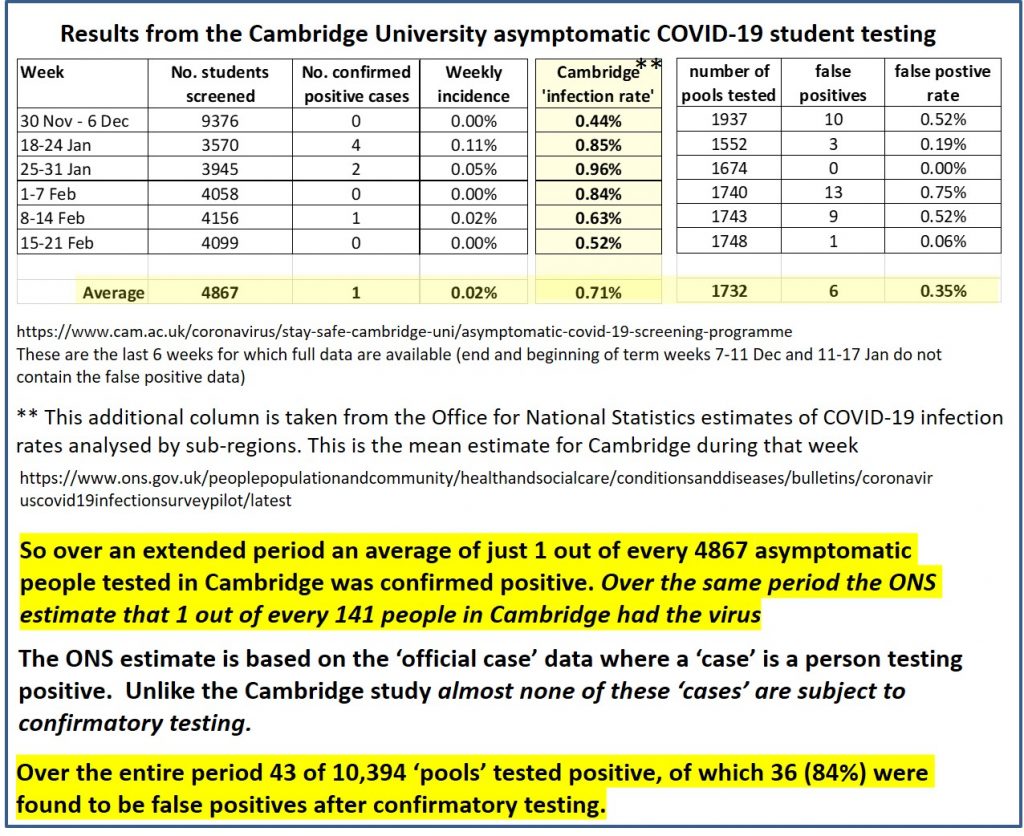
This data also means that if the Government claim that “1 in 3 people with the virus has no symptoms” is correct then the ONS estimated infection rate is massively inflated – the currently reported ‘case’ numbers must be at least 8 times greater than the true number of cases. On the other hand, if the Government estimates of case numbers are correct then at most 1 in 26 people with the virus has no symptoms. Here’s an informal explanation why (formal proof is below):
Cambridge has a population of 129,000.
If the ONS infection estimates for Cambridge (0.71%) are accurate, then during an average week in this period about 916 people had the virus and 128,084 did not.
But if the “1 in 3” claim is correct about 305 people in Cambridge had the virus but no symptoms.
So at most 128,389 people in Cambridge had no symptoms and that means at least 305/128389 people with no symptoms had the virus. That is at least 0.24% (i.e. at least around 1 in 421).
But the study shows on average only 1 in 4867 (0.028%) with no symptoms had the virus. So there should only have been about 36.
That means the “1 in 3” claim and the ONS estimates cannot both be correct.
If the “1 in 3” claim is correct, then the maximum possible value for the infection rate is 0.084% and not 0.71% as claimed (with 0.084% we would have 108 with the virus of whom 36 have no symptoms). So the ONS estimated infection rate is over eight times greater than the true rate.
If the 0.71% infection rate is correct, then the maximum possible value for the proportion of people with the virus who have no symptoms is 3.9% (as this would mean 36 of the 916 people with the virus have no symptoms as predicted by the Cambridge data).
Worth reading Professor Fenton’s conclusions and workings out in full.
Coronavirus (COVID-19) statistics-Global cases.
Updated 6th March 2021. Find Statistics Here:-
Confirmed 116,023,244 + 405,156
Deaths 2,578,785 + 9,363
Recovered 65,569,641 + 186,382
Tony Blair companies receive $22million from the Bill and Melinda Gates Foundation.
By Oliver Down. 16th February 2021. Find Article Here:-
UNN’s Oliver Down has undertaken research into grants received by the Tony Blair Institute from the Bill and Melinda Gates Foundation as well as other initiatives by Tony Blair which include the ‘Tony Blair Africa Governance Initiative’. The results are truly astounding. The first grant was awarded in 2012 and in the ensuing 9 years $21,905,111 has been awarded in grants from the Bill and Melinda Gates Foundation to Tony Blair backed projects at an average of over $2,000,000 per year.
These will be eye-watering sums of money to many especially considering the millions of small businesses destroyed by draconian lockdown policies. The two largest single grants were awarded in 2019, when $3,472,939 was awarded, according to the Bill and Melinda Gates Foundations website: “to support the design and operation of a multi-sector implementation unit in the Office of the President in Burkina Faso” as well as $5,000,000 was awarded “to support the installation and governance of a new agriculture coordination hub located in the Office of the Nigerian Vice President, to guide and support the implementation of two pilot programs” this is again taken from the Bill and Melinda Gates Foundation’s website.
Listen below to what pro-Liberty organisation Big Brother Watch had to say about this:
Tomorrow, Tony Blair will be in the press telling us that digital vaccine passports are “inevitable”.
It’s a lie. A future of digital authoritarianism and discrimination is anything but inevitable.
Our director @silkiecarlo explained why on @BBCRadio4 PM this evening ⬇️ pic.twitter.com/YqLzpowEBG
— Big Brother Watch (@BigBrotherWatch) February 12, 2021
In 2020 alone 6 individual grants were awarded which totalled $6,845,076. In addition to this, in 2015 the Bill and Melinda Gates Foundation awarded a grant to the ‘Cherie Blair Foundation for Women’ for $109,161 “to identify the barriers that exist in a women’s adoption and usage of digital financial services”. Given the volume of and frequency of money that is being awarded to the Blair’s families projects, some may question Tony Blair’s impartiality when he has openly backed incredibly similar globalist policies to Bill Gates that have included vaccine passports.


Who Gets Long Covid, and Why? | Huge Findings From New Study.
By Gez Medinger 6th November 2020. Find 15 min video Here:-
Hancock & Mainstream stay silent as US Company purchases 49 UK GP Surgeries.
BY THE DAILY EXPOSE ON MARCH 1, 2021. Find Article Here:-
A major American health insurance company has managed to get its hands on forty-nine GP surgeries in the United Kingdom whilst the Health Secretary and Mainstream Media have remained silent as they persist with their message to the British Public that they must “stay at home, to protect the NHS” which is being sold off.
Campaigners against privatisation of the NHS have written to Matt Hancock, Secretary of State for Health and Social Care, questioning the legality of the recent takeover of large numbers of GP surgeries in London by the US Corporation Centene following its acquisition of the UK company AT Medics.
In February 2021, Centene, via its UK subsidiary Operose Health Ltd, acquired AT Medics, which operates 49 GP surgeries across 19 London boroughs under Alternative Provider of Medical Services (APMS) contracts and standard contracts, providing services to around 370,000 people, with 900 employees. Until its takeover, AT Medics, was owned by six GP directors.

The campaigners, including Allyson Pollack, director of the Newcastle University Centre for Excellence in Regulatory Science, Peter Roderick, Principal Research Associate, Newcastle University, Jackie Applebee, Chair, Doctors in Unite, Louise Irvine, Secretary, Health Campaigns Together, John Puntis, co-Chair, Keep Our NHS Public, Paul Evans, Director, NHS Support Federation, Steve Carne, 999 Call for the NHS, and Brian Fisher, Chair, Socialist Health Association, question the lack of transparency surrounding the takeover and whether the correct legal processes have been followed by all those involved – AT Medics, 13 Clinical Commissioning Groups (CCGs) and NHS England.
The letter requests that the Secretary of State exercises his power under section 48 of the Health and Social Care Act 2008 to request the Care Quality Commission conduct an investigation into NHS England and the 13 CCGs involved in authorising the take-over of the GP surgery contracts held by AT Medics.
Under APMS contracts, such as those held by AT Medics, the “contractor must not sell, assign or otherwise dispose of the benefit of any of its rights under the APMS contract without the prior consent of [NHS England]”. At some point in 2020, AT Medics Ltd sought prior authorisation from commissioners for the takeover and the transfer of the APMS contracts to Operose Health Ltd. and CCGs began the process to approve the change of ownership.
An investigation by the campaigners, however, has found a “lack of openness, transparency and misrepresentation” by the CCGs involved. The 13 CCGs involved – Barking & Dagenham, Brent, Central London, City & Hackney, Hammersmith & Fulham, Harrow, Newham, North Central London (NCL), Redbridge, Tower Hamlets, West London, South West London and South East London – have published very few documents on the change of ownership and held no public meetings.

Where CCGs have published information, such as North Central London (NCL) CCG, there were no meetings where the public could participate and any mention of Centene was not put in the public domain until after the CCG had made its decision.
On 17 December 2020, conditional authorisation was given for a change of contractor for the APMS contracts at eight practices in Camden, Islington and Haringey, by NCL CCG’s Primary Care Commissioning Committee at a virtual meeting; the public were not allowed to participate. At this meeting the presenter also said that there would be no change of directors at AT Medics, despite the change of ownership; this later transpired to not be the case.
The investigation by the campaigners has also brought to light a previous change of control for AT Medics Ltd in 2019, when it changed from a Ltd company to a Limited Liability Partnership (LLP), that the campaigners believe should have been reported to the CCGs under the rules of the APMS contracts.
It is not currently known whether prior authorisation was sought or given for the change from Ltd to LLP. If this didn’t happen then, the campaigners note, it is “a serious breach under paragraph 63 of the APMS contract.”
Finally, the letter questions the involvement of NHS England in the process and the campaigners want the investigation to look at the “role, advice and instructions of and on behalf of NHSE in relation to the CCGs”, and establish whether any “improper influence or control was exerted.”
AT Medics’ new owner, Operose Health was formed in January 2020, when Centene Corporation brought together its subsidiaries in the UK – The Practice Group (TPG) and Simplify Health. The Practice Group, which had a number of GP surgery contracts, was acquired by Centene in 2017. Operose’s direct parent company in the UK is MH Services International (UK) Ltd.
The takeover of AT Medics was finalised 10 February 2021, when the directors of AT Medics Limited resigned and were replaced by Samantha Jones (CEO of Operose and ex-head of NHS England’s new care models programme), Nick Harding (Director of Operose and formerly Senior Medical Advisor to NHS England for Integrated Care Systems and Right Care) and Edward McKensie-Boyle, Chief Financial Officer of Operose.
Operose Health adds the AT Medics’ 49 London GP surgeries to its 20 GP surgeries and one urgent treatment centre in Birmingham. In addition, the company lists on its website ten ophthalmology services and a single dermatology clinic in Kent.
Six of AT Medics’ APMS contracts are relatively newly acquired, won in early 2020 when it successfully bid on lots in the contract “PRJ736 — London APMS GP Contracts”. Each APMS contract runs for 15 years and the six are worth a total of just over £121 million.
The US corporation Centene has over 30,000 employees in the USA and operates health insurance plans for around 2.9 million people in 24 US states. The company acts as an intermediary with Medicare, Medicaid, and The Health Insurance Marketplace System, as well as traditional commercial insurance. In early 2020, Centene took a large stake in Circle Health, the UK’s largest provider of private hospitals.
If oestrogen can save women from the worst of Covid, they should be given it.
By Kate Muir. February 28th 2021. Find Article Here:-
There is mounting evidence that HRT can help menopausal women recover from the virus, but little action is being taken.
‘To see what is in front of one’s nose needs a constant struggle,” wrote George Orwell, and seeing in front of our masks in this endless pandemic turns out to be even harder.
Take the compelling case of the effect of oestrogen, the female hormone, on the coronavirus. Quite simply, research suggests that women with more oestrogen in their bodies are less likely to die and more likely to have milder symptoms of Covid-19. Doctors are also discovering that topping up low hormone levels seems to help some women suffering from long Covid. Yet, this area of research is being sorely neglected. I wonder why?
We know that two thirds of coronavirus deaths occur in men. But the female Covid mortality rate starts to rapidly increase as women hit their fifties – after menopause, when their protective hormones, oestrogen and progesterone, drain away.
It turns out, however, that women who take either the combined contraceptive pill or hormone replacement therapy – both of which include oestrogen – have a lower risk of ending up in hospital and of dying. Generally, oestrogen enhances the immune system, while testosterone has an immunosuppressive effect.
As Caroline Criado Perez’s book Invisible Women – Exposing Data Bias in a World Designed for Men, says, gender blindness in medicine and areas like tech just produces a “one-size-fits-men” culture. There is a gender data gap here that is not just irritating, but life threatening.
I’ve become fascinated by oestrogen’s superpowers during research over the past year for a book and an forthcoming Channel 4 documentary about the menopause. Aside from being a female sex hormone, oestrogen does sterling work throughout the body and brain. It regulates immunity and inflammation, and that terrifying “cytokine storm”, which rips coronavirus patients apart in hospitals, is less severe in women than men.
Hormone replacement therapy comes in many forms now. The latest body-identical hormones are a big improvement on the early synthetic ones that brought screaming headlines on the risks of breast cancer. When the newer transdermal oestrogen HRT – a £4-a-month gel or patch – is used, it’s been proven to protect women from heart attacks, osteoporosis, diabetes, colon cancer and memory loss, as well as stopping hot flushes. Why not Covid-19 too?
The good news is that it might. A recent study of more than 5,451 deaths in women from 465 GP practices in the Oxford Royal College of General Practitioners database showed that women who were using any form of HRT were 78% less likely to die of Covid. Of course, there’s a slight healthy user bias for women who opt to take HRT, but that’s still a mighty protective effect.
In September, the Zoe Covid Symptom Study app showed that women on the contraceptive pill were less likely to catch the virus. Later, a TriNetX global database survey from 17 countries, showed women taking oestrogen HRT were 50% less likely to die of the virus.
The science on oestrogen is not all there yet – we need more extensive studies as we follow the trail from hospital to patients at home with long Covid. An online survey of 1,294 women suffering the miserable symptoms of long Covid found a majority reported that their periods had changed and said their symptoms were worse before or during their periods when oestrogen levels are at their lowest.
The Covid app found that long Covid is particularly prevalent in women between the ages of 50 and 60 and, aside from respiratory problems, the rest of the reported symptoms in women have a huge crossover with those of menopause – fatigue, insomnia, brain fog, joint pain and heart palpitations.
Dr Louise Newson, a menopause specialist, said: “These symptoms are likely to be related to low oestrogen and also testosterone levels in women, so consideration should be given as a priority to replacing these low hormone levels with the right dose and type of HRT.”
So far, Newson and others have treated a number of patients of menopausal age privately with HRT, and their Covid symptoms have improved or disappeared. But there’s no suggestion of hormonal help on the long Covid section of the NHS website.
NHS experts have seen these latest academic papers on hormones, HRT and long Covid, but so far there’s been no announcement of further research – or hands-on treatment with oestrogen, a cheap drug we already know to be safe. The NHS website has pages of information on long Covid, but the suggested solution to chronic fatigue is “get a good night’s sleep”.
Science bends and sways with the news cycle: rules and vaccine doses change not always because of medical proof, but according to government expediency. Research is fast-forwarded in these times of trouble, so why has oestrogen been left behind? Any answers, gentlemen?
Kate Muir’s book on the menopause is published by Simon and Schuster this summer.
Clean break: the risk of catching Covid from surfaces overblown, experts say.
By Melissa Davey. 27th February 2021. Find Article Here:-
Prioritising eye protection and face masks will prevent the spread of coronavirus more than disinfecting surfaces, research shows.
When cases of Covid-19 first began emerging in Australia, some people reported disinfecting their groceries before bringing them into their homes, and there were also concerns that the virus could be living on the surfaces of packages in the mail. During Victoria’s extended lockdown, teams of workers could be seen walking city streets disinfecting traffic light buttons, benches and even fences.
An epidemiologist with La Trobe University, Associate Prof Hassan Vally, said just over one year later it has become clear surface transmission is not as significant a factor in Covid-19 spread as once feared. While surface transmission is not impossible, Vally said its role in spread needs perspective.
“I want to be clear that nothing should change in terms of washing our hands and personal hygiene,” Vally said. “We can, however, be less anxious about washing every surface 20 times a day, and just concentrate on good hand hygiene and social distancing, and staying home when sick, which should be more than enough to stop us from spreading the virus.”
Close contact aerosol spread is the driving factor in Covid-19 transmission, primarily when an infected person is in close contact with another person and transmit small liquid particles [droplets and aerosols] containing the virus, especially when they cough and sneeze. These aerosols then get into the nose, mouth and eyes of people nearby.
In a piece for the Conversation, Vally said: “This isn’t to say surface transmission isn’t possible and that it doesn’t pose a risk in certain situations, or that we should disregard it completely. But, we should acknowledge the threat surface transmission poses is relatively small.”
Emanuel Goldman, a professor of microbiology at Rutgers University in the US, wrote in medical journal the Lancet that studies warning of surface transmission had been conducted in the lab, and “have little resemblance to real-life scenarios”.
“In my opinion, the chance of transmission through inanimate surfaces is very small, and only in instances where an infected person coughs or sneezes on the surface, and someone else touches that surface soon after the cough or sneeze (within 1–2 hours),” Goldman said.
“I do not disagree with erring on the side of caution, but this can go to extremes not justified by the data.” Periodically disinfecting surfaces and use of gloves may be reasonable precautions in settings like hospitals, he said, but is probably overkill for less risky environments.
Fuelling the concern about surface spread were seemingly alarming but overblown studies, including one from the Australian government agency CSIRO that found a droplet of fluid containing the virus at concentrations similar to levels observed in infected patients could survive on surfaces such as cash and glass for up to 28 days.
What many of the news reports about the study failed to mention was that it was carried out in the dark to remove the effect of ultraviolet light which helps to kill viruses. Humidity and temperatures in the real world vary constantly, which is different to carefully controlled temperatures in a laboratory. Mail, for example, will go through different humidities and temperatures throughout the system and will also be exposed to light, making survival of the virus in the post extremely unlikely.
The science wasn’t wrong, Vally said, but the interpretation and explanation of the results was.
But isn’t too many hygiene measures better to be absolutely safe?
Vally said the issue was compliance fatigue.
“There’s been a lot of psychological research done that says that we only have a certain amount of willpower and a certain amount of detail that we can focus our attention on,” Vally said. “That’s why Apple founder Steve Jobs wore the same clothes every day, based on the idea you can only make so many decisions each day, and exercise certain amount of willpower.
“To me as we learn more about the virus, we should make sure we are not being worried about things we shouldn’t be worried about, we don’t want to focus our attention on things disproportionate to the threat that they pose. That way, we will have more energy to focus on the things that are important, and that helps us to save money and time as well.”
Peter Collignon, an infectious diseases physician and professor with the Australian National University, agreed all the available evidence says it’s people in close proximity with each other talking, coughing, singing and breathing heavily that drives virus spread.
“They’re breathing them in and it’s getting into their nose and eyes and that is the major risk factor,” he said. It’s why eye protection, particularly in quarantine hotels and hospitals, should be prioritised as much as masks and social distancing, he said.
Collignon cites a large study published in the Journal of the American Medical Association that found 19% of healthcare workers became infected, despite wearing three-layered surgical masks, gloves and shoe covers and using alcohol rub. After the introduction of face shields, no worker was infected.
“I think we’ve underappreciated how important the eyes are and overemphasised surfaces,” Collignon said.
 The Truth is Where?